
Andrea Carlson (b. 1979) is an indigenous artist whose work interrogates access, denial, art historical narratives, Mondo films, repetition, indigenous knowledge, and repatriation. Based in Minnesota, Carlson is descended from the Grand Portage Band of Ojibwe and is the co-founder of the Center for Native Futures in Chicago. She earned her BA from the University of Minnesota and her MFA in Visual Studies from the Minneapolis College of Art and Design (MCAD), and has since received countless accolades for her work.
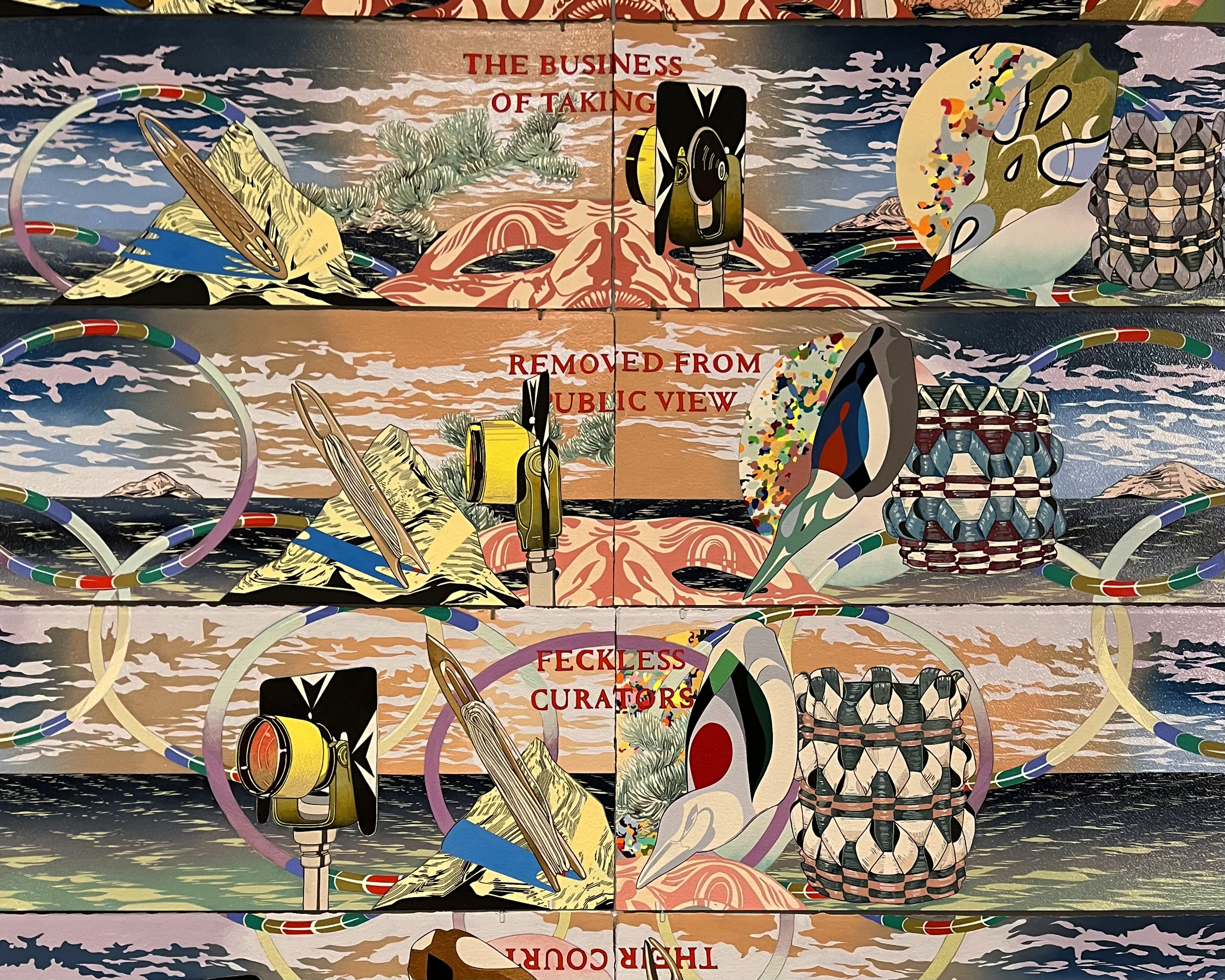
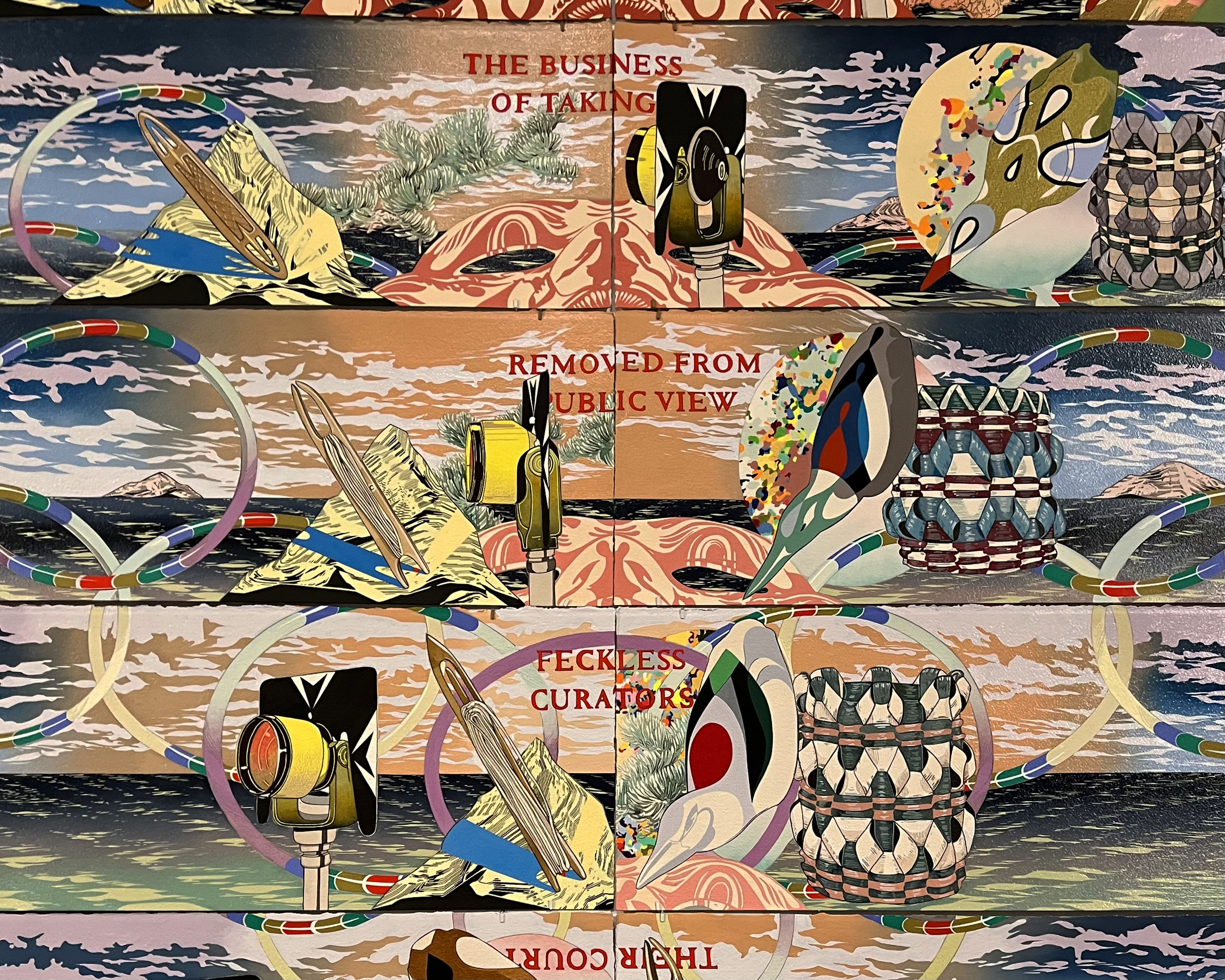
Detail, The Constant Sky, 2025. Oil, acrylic, ink, colored pencil, graphite, gouache, pastel, and watercolor on paper. 9’-7” x 15’-3”.
In October 2025, the first museum survey of Carlson’s work opened at the Denver Art Museum. This exhibit brought together an incredible breadth of work spanning the last twenty years of her career, and culminating with a new work commissioned for the museum, The Constant Sky, for which the exhibit is named.
The exhibit ran until February 16, 2026, closing with a conversation between Andrea Carlson and Rory Padeken, a Curator of Modern and Contemporary Art at the DAM. The talk was enthusiastically attended, and the audience seamlessly connected with Carlson as she brought insight to her practice and her preferred medium (Arches 400lb Watercolor Paper). I had the opportunity to connect with Carlson, who told me not to quit architecture when I joked that she inspired me to become a visual artist instead. As a compromise, I asked for an interview about her work, and how to contend with museum architecture.
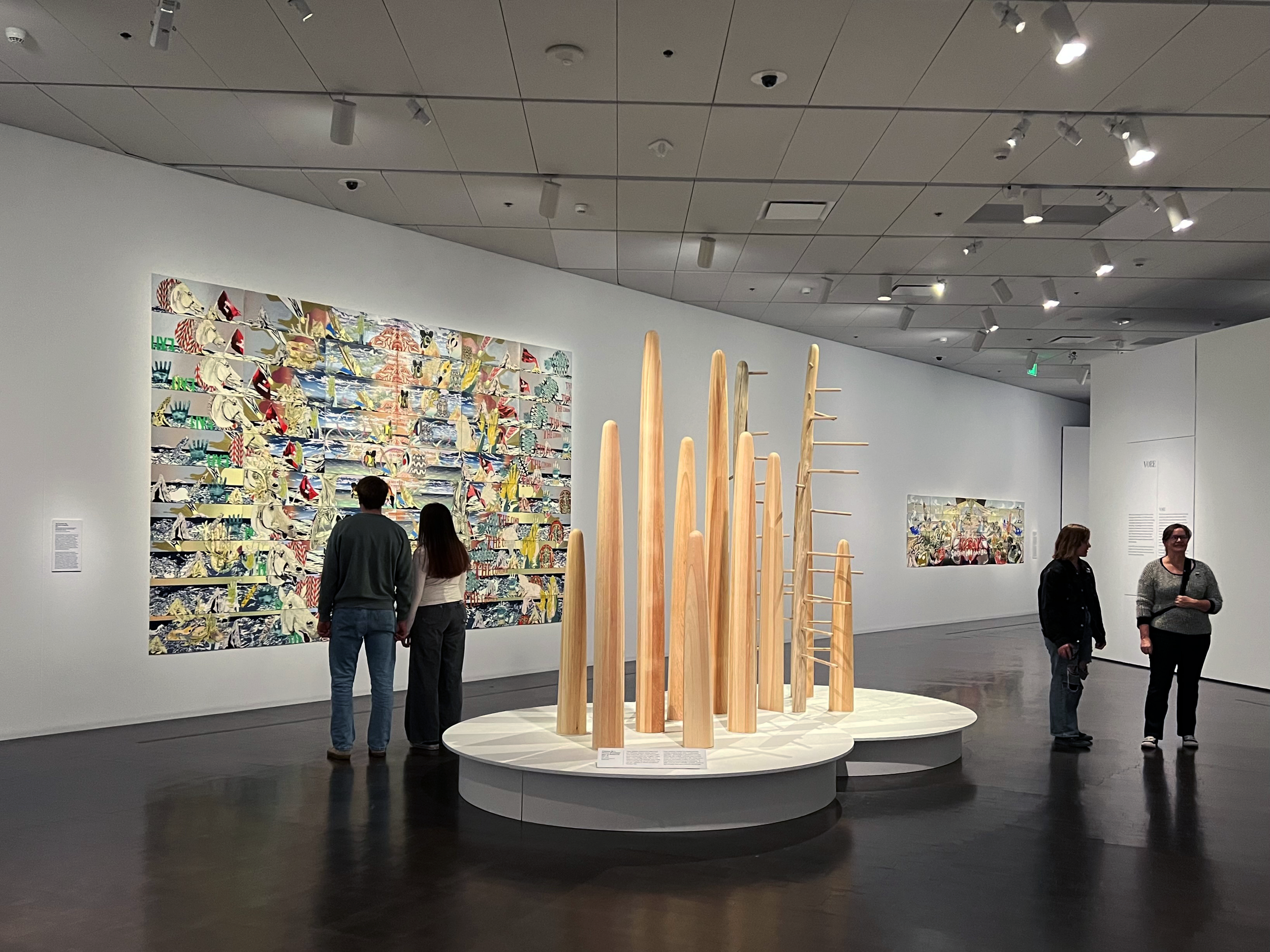
Gallery View, The Constant Sky and Columns for a Horizon at the Denver Art Museum.
Aryana Leland (AL): Your work The Constant Sky was commissioned for the Denver Art Museum, and accompanied by the sculpture Columns for a Horizon in the gallery space. The placement is deliberate, where a viewer cannot step back and view the work head-on without stepping around and viewing through the columns. Your work often interrogates repatriation, the relationship between museum and artist, and a sense of access and denial. Do you envision that works in the Stacked Landscapes series should be accompanied by Columns for a Horizon in order to interrogate this access and context? Are you interested in further exploring sculpture in your work?
Andrea Carlson (AC): Absolutely yes to more sculpture! The scale of the larger works, like the Stacked Landscapes works, were too explorable, too easy to navigate when a viewer is sitting with the work. I wanted people to have to physically conform to the space: either get an edited view of my paintings/drawings through the sculptures or be forced into an intimate space by going past the sculpture and nearer to the drawings. There is a simplicity to the wooden columns that I feel counters the near Baroque ornateness of the works on paper. That contrast is intentional.
There are two sculpture forms in the set that were a singular drift log that I pulled off of the beach in front of my house on Lake Superior. I cut it in half and each part was as tall as the other turned columns. I enlisted my father, Rudolph Carlson, and studio manager, Josie Hoffman, to help shape the logs and replace every damaged branch with dowels. We noticed that the dowels were mostly along one side of the tree and that they must have grown that way. I think this might be because the southern side of the tree would receive more sunlight while the northern side would be in the shadow and receive more wind and coldness. When those forms were installed in the gallery we positioned the heavily doweled side towards the south in keeping with this theory. This ordering of the sculpture also draws inspiration from a similar sculpture at the Toronto Biennial. I shipped a number of wooden birds to be arranged on various sized columns and left the decision to the curator. This was during the pandemic, so it was impossible for me to be there for installation of the work. Candace Hopkins, who co-curated it, helped place the birds. She texted saying that the birds of prey were attached to the taller columns and the waterfowl were on the lowest columns. Song birds were in the middle. I didn’t even think of the strata of birds. It was a brilliant decision, so when the drift log was discovered to have a reason in its form and we arranged them to support that reason, it was in keeping with prior work.
AL: In the video created for the exhibit, you appropriately speak to the fact that "there's a desire there to kind of to decode my work in a way." This is reiterated in your interview with Dakota Hoska, and this desire is also present within the exhibit. Visitors will spend time with your work pointing to specific references and symbolism, trying to decipher their meaning. It seems that each work tells a very clear, deliberate story for those with eyes to see it. Rather than asking you to translate it, what do you wish museum-goers would take away from your work? What is our responsibility as viewers?
AC: First, I want enjoyment out of the work. I want the seduction of the colors and tight formal rendering to pull people in and be satisfied with the craftsmanship. That is intentional, or what I am trying for. If the viewer is drawn in, maybe they become invested in the image, and feel the care I put into these spaces. Maybe, and not even an expectation on my part, but just maybe, they will read about the work, consider my musings about the world and my ideas about the land we inhabit, their place in it, and complexities of place, including the museum space. The enjoyment that the audience might feel around my work is immediately questioned by that very audience. Are they supposed to enjoy it, do they trust it, what should they be feeling? Even if the ideas behind the art are complex, I will give anyone permission to enjoy it. And some of the ideas are hard. I get into the Windigo, the cannibal as a metaphor for colonization. These malevolent winds that blow around us in colonized lands. There is a commentary on sexism and racism that lives in images and associations. One thing that I don’t like so much is when the work becomes a codex, and the audience wants to decode everything. Some decisions were made and there isn’t a complex idea behind those decisions, at first. Some decisions were made that I may figure out later.
There is something new for me that I’m starting to consider about the location where my work is seen. I want non-me people to have an even finer resolution with my work, for some of the works to have both the intimacy of being lived with as well as enjoyed in non-museum places. I don’t live in a home with much of my own work on the walls and I wonder what that would be like. I think there are some collectors and friends who know my work differently than I do because they see it every day. The art on my walls from other artists is precious to me. I’ve let a print by Julie Buffalohead and Fritz Scholder really be held in my daily space, as well as painting and drawings from Joe Sinness and Jim Denomie. I wonder if I’m having this effect on people who live with my work on their walls.
AL: The Hamilton Building at the Denver Art Museum was designed by architect Daniel Libeskind, whose design sensibilities often create a form that is bold and sculptural, but with the consequence of interior spaces that are difficult to inhabit (and maintain). Due to this condition, the exhibition space for A Constant Sky takes on an irregular shape, maybe even one that is disorienting, angular, and sharp. How did you contend with this exhibition space, and how does it interact with your work? What was your role in the placement and sequence of the works in the gallery?
AC: Oh my god, that space. The outer walls of the gallery my work was in has metal plating in the walls. I think there was some conspiracy of someone attached to the building of the museum having an interest in the metal industry. I don’t actually know the story, so I might be spreading nonsense. The metal made it hard to hang my work with the “L” pins, but the team at DAM had clever work-arounds. That space is theirs to creatively accommodate, but they didn’t make me compromise on how I like my work installed. I appreciate that because it is a total act of trust to put works on paper on the walls without glazing, raw and vulnerable to the violence of our times. So far, fingers crossed, no damage. People, primarily artists, tell me that they appreciate being able to see the work raw on the wall. They like to see the work without the glare of the glass, without another glass screen. That is the reason you might want to see the work in person and not online, that and the scale.
The placement of the work in this exhibition was like flower arrangement. I knew I wanted RED EXIT and Ink Babel next to each other. I didn’t want a timeline of works that would support a narrative of progress or linear development of the work to emerge. The large works are anchors in the space and the smaller works weave them together.
AL: Where do your upcoming artistic pursuits and focuses lie? Do you have any upcoming exhibitions that you would like to share?
AC: I’m heading to the Contemporary Art Museum St. Louis right now for the opening of Endless Sunshine, a solo exhibition curated by Misa Jeffereis. This show features nine new large works on paper and a few older works. The Constant Sky is traveling to the Ringling Museum in Florida, and the Nasher Museum in North Carolina. I’m also represented by the Jessica Silverman Gallery in San Francisco. The work is around.
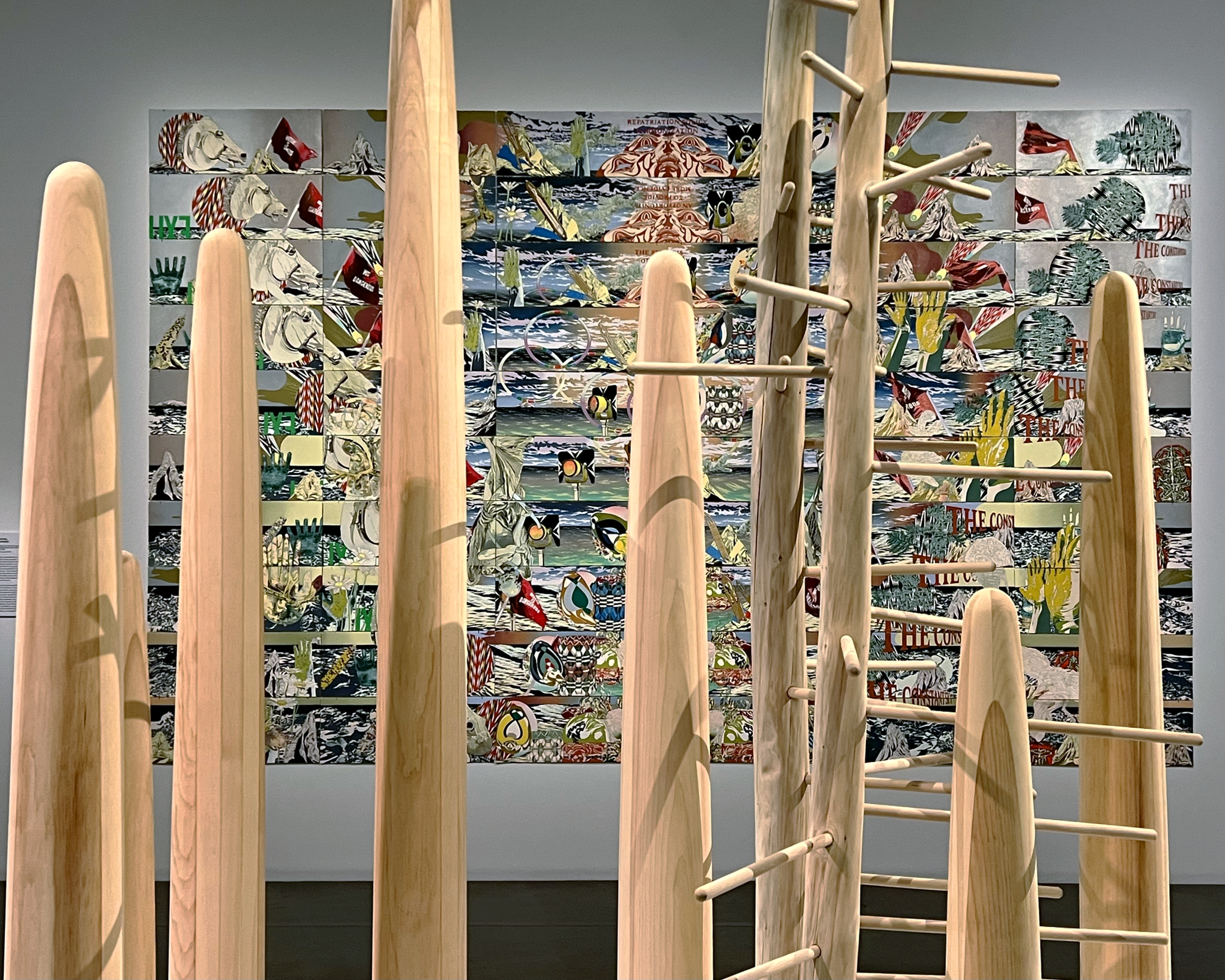
Columns for a Horizon and The Constant Sky and at the Denver Art Museum.
Andrea Carlson’s latest exhibit, Endless Sunshine, opened at the Contemporary Art Museum St. Louis just last week, and is on view until Aug 9, 2026. Andrea Carlson: A Constant Sky as organized by the Denver Art Museum is traveling to the Ringling Museum in Sarasota, FL this May. I cannot recommend enough seeing Carlson’s work in person.
Special thanks to Studio Manager Brian Wagner, who facilitated this interview, and the curious, informed docents and volunteers at the Denver Art Museum, who I peppered with questions.
The Denver Art Museum is situated on the homeland of the Arapaho, Cheyenne, and Ute people, and you can learn more about the museum’s Commitment to Indigenous Communities here.
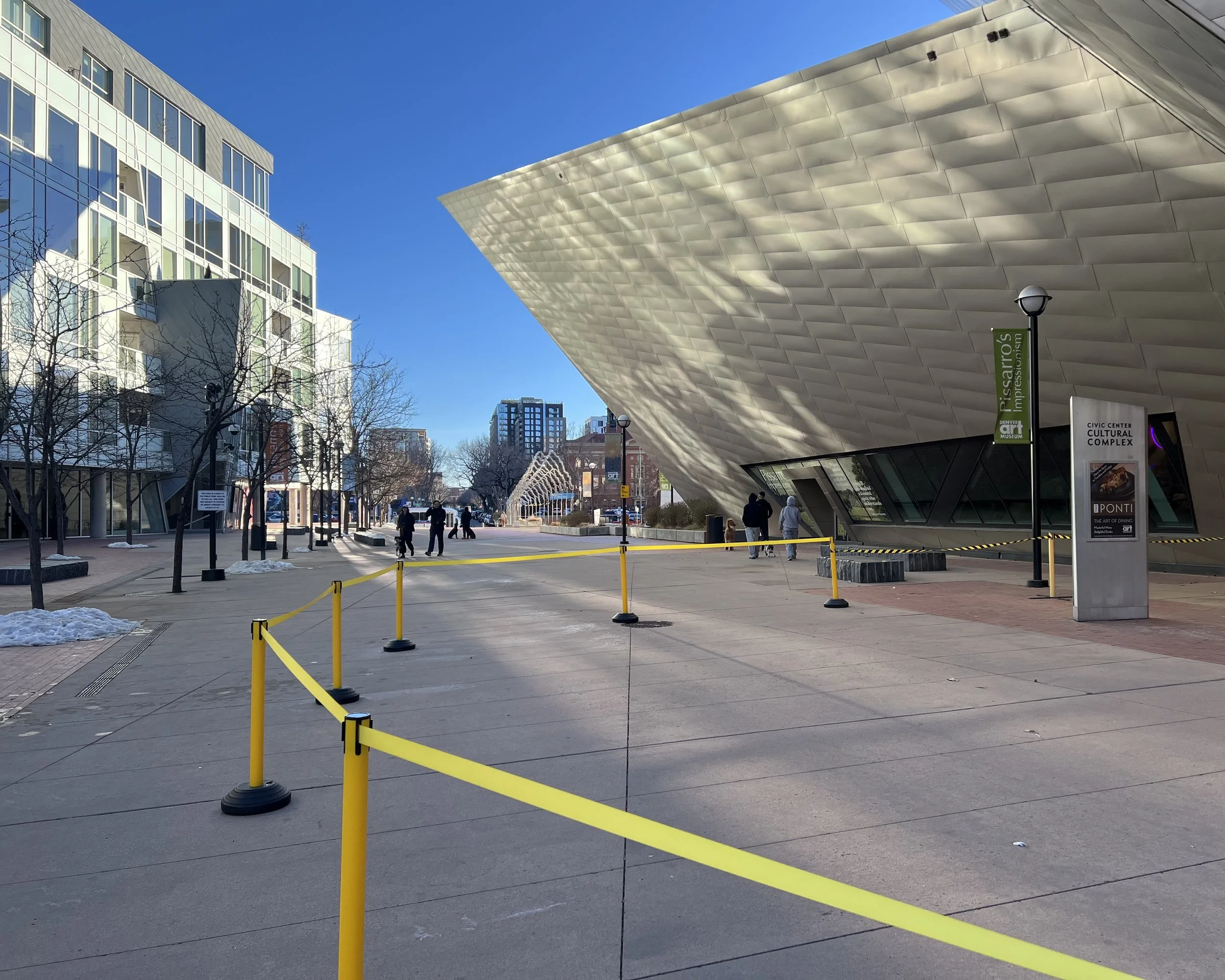
Safety First: The museum must take extra precautions when ice thaws off the roof over the main entrance of the Hamilton Building
Aryana Leland is an aspiring architect (who promises not to quit) based in Denver, Colorado. She earned her Bachelor of Architecture with a Minor in Art History from Cal Poly Pomona.
All opinions are my own.