
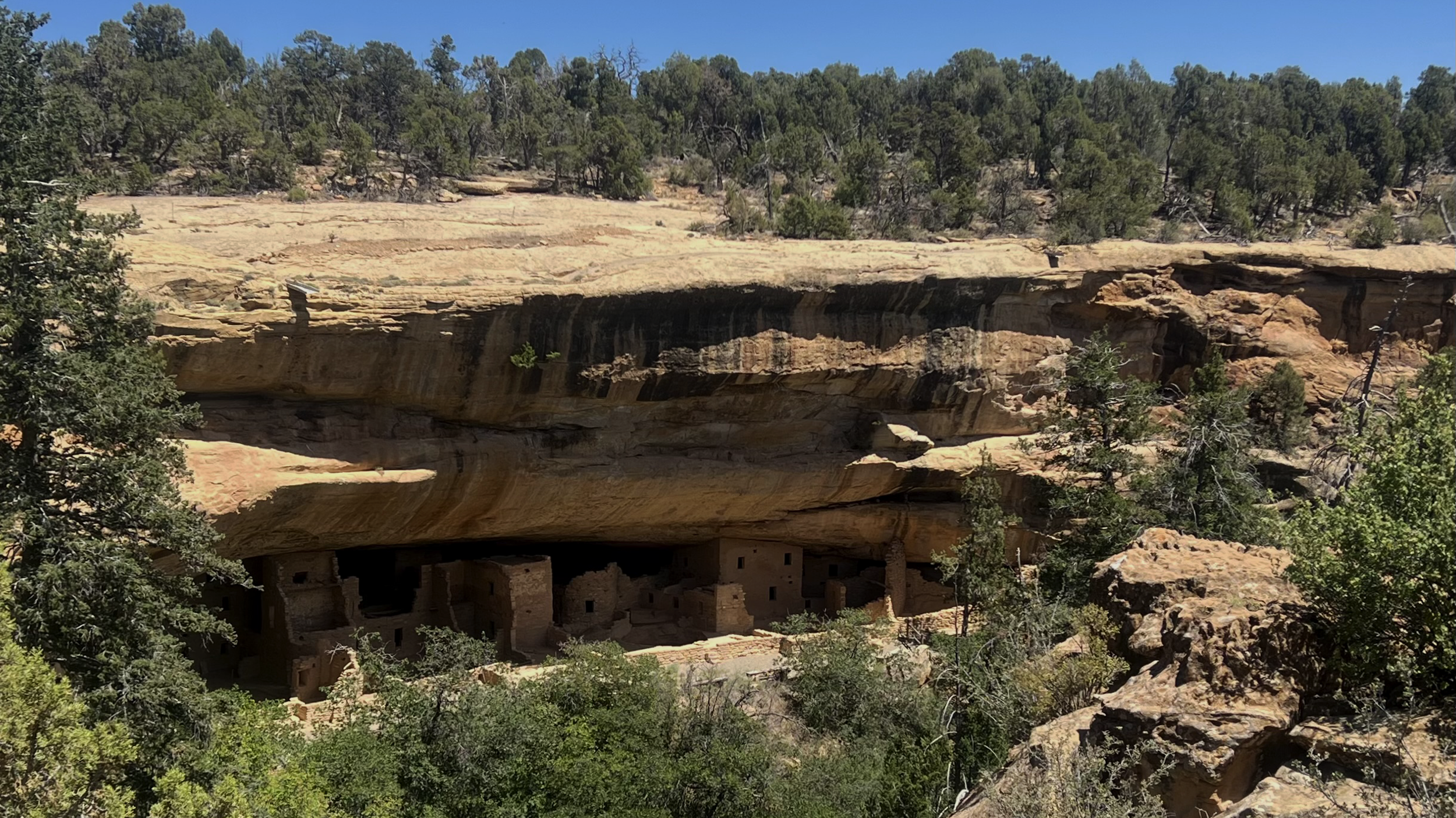
A park ranger descended the eroded asphalt path, deteriorated by the Southern Colorado sun. He found refuge in the shade as visitors gathered under the timber portico, a black dog panting at his owner's feet. “Where is everyone visiting from?” The woman with a bubbling baby, who had been voicing her displeasure towards her husband at the last turnout, barked “Fort Wayne, Indiana.” I heard exhaustion through her midwest accent while her husband stared blankly with his mouth ajar, donning an “America 250” shirt. Another husband with sunned skin and a Harley Davidson cutoff replied politely “Montreal.”
The ranger turned to us expectantly. Sometimes when my boyfriend is feeling untethered he will align himself with a higher education - “Bloomington, Indiana.” There are roughly twenty cities named Bloomington in the United States, so he has to clarify. Sometimes I will follow with “Southern California,” because it’s less embarrassing than Orange County, but less of a conversation-starter than San Clemente (where is that)? This afternoon though, I let him settle on Denver for the both of us. The tour guide nodded emphatically - “looks like we’ve got some Colorado natives!” I didn’t correct him.
He launched into his practiced talk, pointing at infrastructure, feats of engineering, a reconstructed kiva, man-made drainage paths, and scuppers that were delightfully erected by a man fifty years ago. Despite his best efforts, the sandstone arch will collapse at any moment, so park visitors are no longer allowed to loiter in front of the Spruce Tree House.
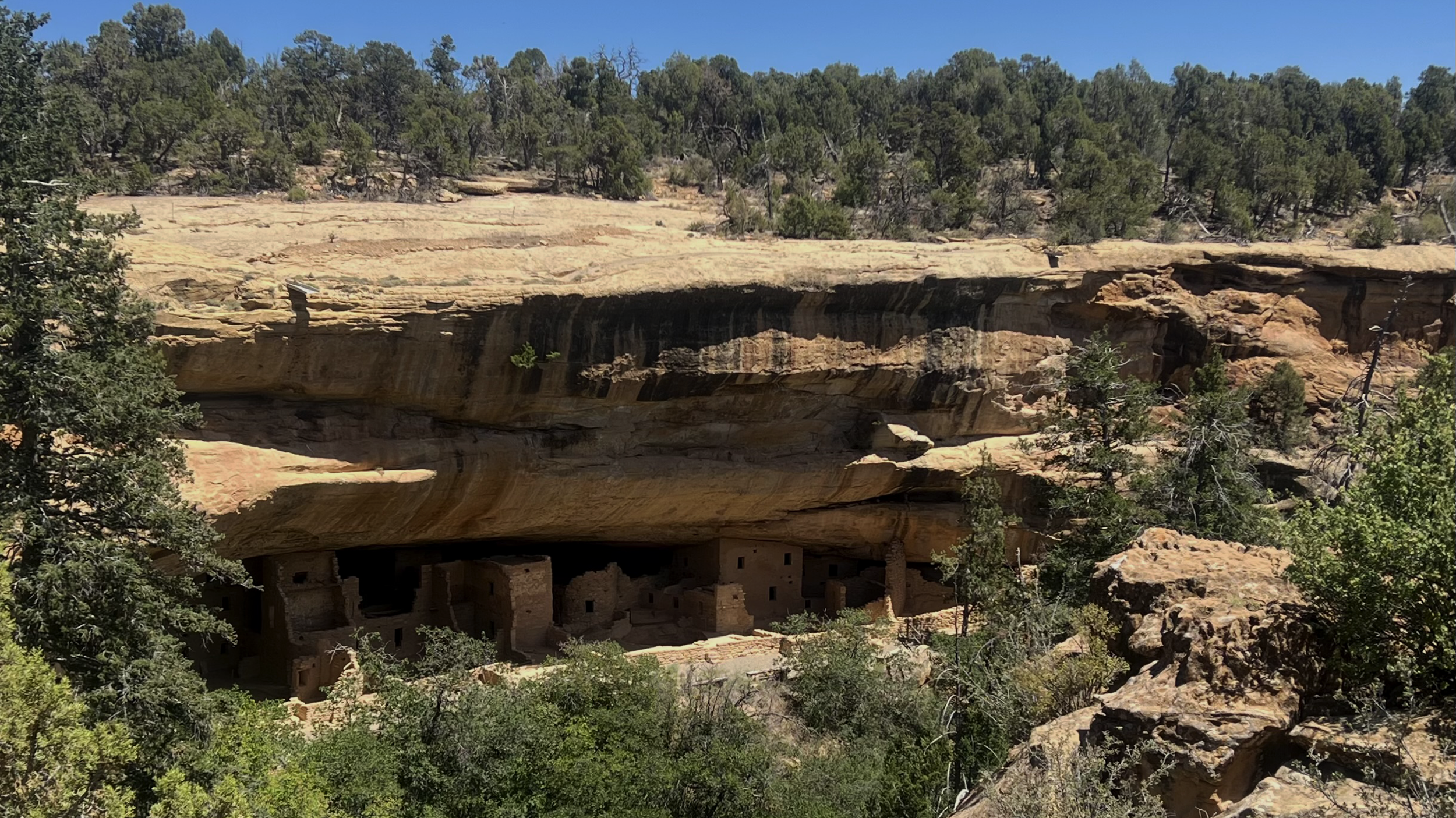
View of Spruce Tree House with drainage scuppers at cliff edge
“How long do you think we should preserve this for?” Unsure silence until the Canadian biker replied softly.
“Forever?”
“Okay! How many people want to see a big ugly metal thing on the cliff?”
He curved his arm in gesture of the stone arch across the ravine. No one answered his rhetorical question. He explained that as a National Park, it was their duty to preserve the land for future generations, including these cliff dwellings at Mesa Verde National Park. The structures have also been declared a UNESCO World Heritage Site, increasing this responsibility. He referred vaguely to consulting with local tribes, but the fact remains that the architecture at Mesa Verde dates back to 600 CE. His practiced narrative explains that the issue of preservation depends on who you ask, with opinions differing between tribal elders and tribal members. According to the ranger, bureaucracy seems to be alive and well in all Four Corners of America.
The United States’ history of displacement and abuse of Native Americans has resulted in systemic issues that continue to disenfranchise and harm tribal communities today. Violence against native women has become a national crisis - on some reservations, women are murdered at a rate ten times the national average, resulting in the Missing and Murdered Indigenous Women and Relatives (MMIWR) movement.¹ During Donald Trump’s first term, the national poverty rate for white Americans was 8.1%, while Native Americans experienced a poverty rate three times higher at 25.4%.² National Parks have been caught in the crossfire, being asked to censor historical narratives at federal sites while justifying the preservation of Native American architecture to legitimize an American identity past 250 years.
MESA VERDE NATIONAL PARK
I asked the Ranger what the kivas were used for, which were visible from our lookout across the ravine.
“You know, I imagine them like big multipurpose rooms. In the winter I like to think that people huddled around the fire to stay warm.”
It wasn’t a fair question as I recalled the emphasis of my Native Arts professor explaining that kivas were sacred, ceremonial spaces, where the act of descending into the earth was spiritually significant. Since their construction in the 13th Century, many of the timber roofs had collapsed and the kivas were open to the public - Americans, Canadians, and panting dogs alike. One of the kivas at Spruce Tree House has a reconstructed roof, though indistinguishable from the rest of the structure.
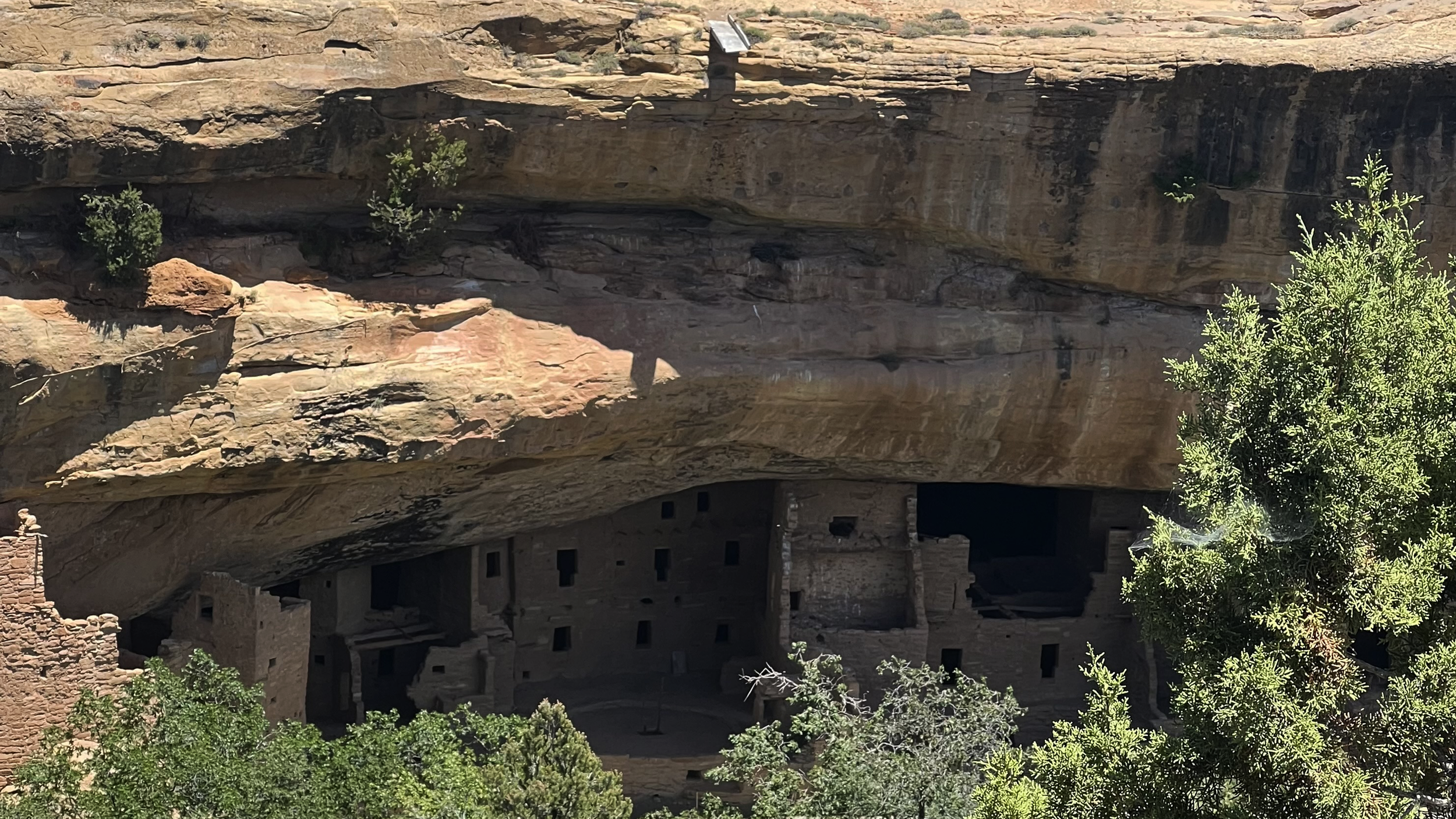
Kiva at Spruce Tree House with reconstructed roof, drainage scupper at cliff edge above
The Southwest has earned a spot in popular culture as a harsh, unknown landscape - Area 51, Breaking Bad, Roswell, the Manhattan Project - a region that is unwillingly, or secretly, inhabited. 850 years ago, Ancestral Puebloans thrived in the Southwest, and more specifically the Four Corners region: Arizona, New Mexico, Utah, and Colorado. In 2006, Craig Childs published House of Rain: Tracking a Vanished Civilization Across the American Southwest, simultaneously tracking a midlife crisis through the Four Corners region that reads like John Krakauer sleeping under an overpass (this is true, by the way). Twenty years later, this book has earned top shelf real estate in Mesa Verde National Park’s gift shop. After translating his references to the Anasazi (an outdated term for the Ancestral Pueblo people), I started to understand this architectural history past the park boundary. Despite his questionable water sources and semantics, Childs documents a fascinating journey tracing the Ancestral Puebloan’s migration and trade routes across the Southwest, a complex system that hasn’t been fully uncovered to this day. His research helped to confirm that the people of Mesa Verde were certainly not isolated from other Native American communities in the Southwest, and created prolific art and architecture in their time at Mesa Verde.
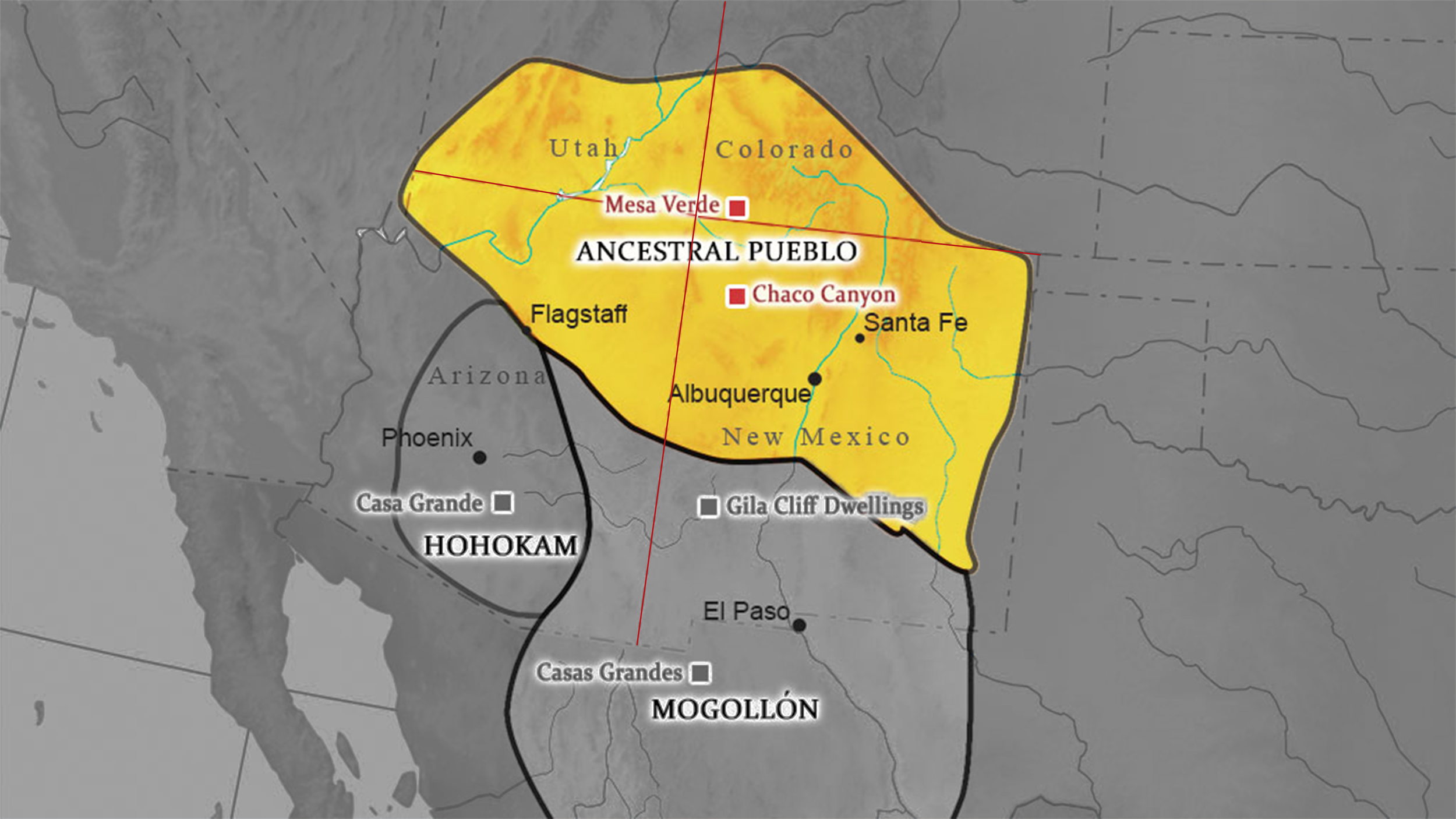
Ancestral Pueblo History in the Four Corners Region
On Chapin Mesa within the park, Spruce Tree House was constructed from 1200-1270 CE through an additive process. Similar to other cliff dwellings, this elaborate structure is tucked into a naturally occurring sandstone arch, formed over millions of years of geologic processes. One of the primary features of Ancestral Pueblo architecture is the presence of a kiva, a large, round, subterranean space ringed by a continuous bench. Kivas are fitted with an exhaust flue, a stone that acts as a smoke damper, and a pit in the center for a fire. At each site across the Southwest, kivas vary in size and quantity. Spruce Tree House, one of the best preserved at Mesa Verde, features eight kivas and 130 rooms. The entire structure spans 216 feet wide and 89 feet deep into the sandstone cliff.
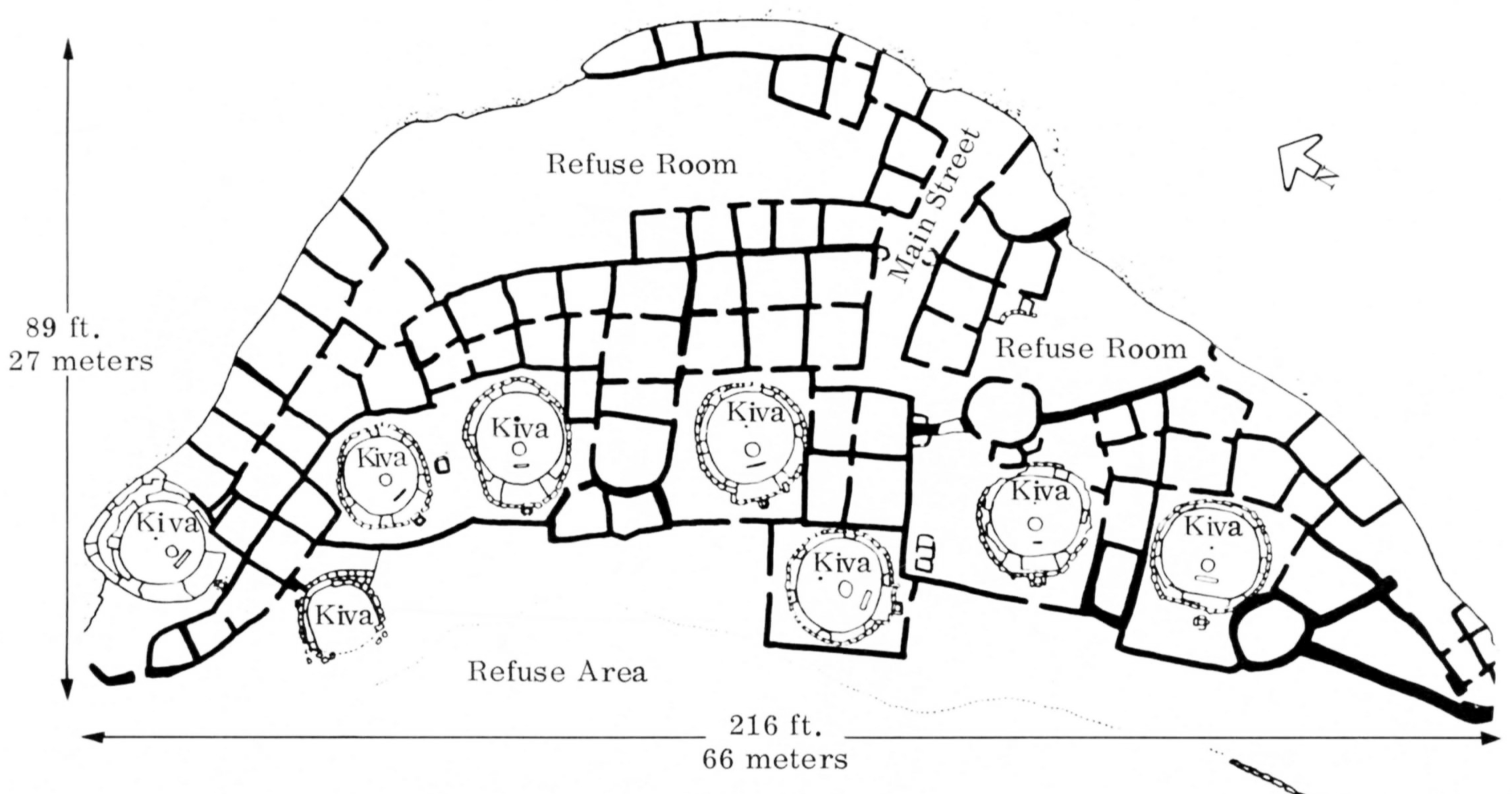
Plan of Spruce Tree House from 1986 Mesa Verde Museum Brochure
Spruce Tree House is primarily masonry construction, with roofs and floors crafted with wooden logs. Throughout the park, cliff dwellings can be dated by analyzing when the lumber was felled for construction. Today, many of the original wood elements have collapsed, leaving kivas exposed to the elements and potentially misinterpreted by the average visitor.
Spruce Tree House has been closed to visitors for over a decade now due to rockfall. The National Park Service has contracted with a geotechnical engineer to assess stabilization of the cliff, which threatens to collapse. The park has planned for a four-phase approach, of which the first two are underway.³ At nearby Arches National Park, diagrams manage visitors’ expectations by explaining that every sandstone arch you see will eventually collapse as part of the natural process that formed it. Sandstone is especially prone to erosion, but at Mesa Verde the NPS is fighting back in American fashion.
Within the park, the preservation and display of these sites is at a crossroads. The Mesa Verde Museum is currently undergoing a massive overhaul, citing that “the original exhibits focused on the story of the park from the lens of 20th century archeology. Not only has the discipline of archeology changed over the years, but the exhibits did not include the perspectives of the tribal communities for whom this place is sacred.” ⁴ The park also seems to be having an identity crisis between AD and CE on its signage, right next to a high resolution image of a low-flow toilet proving the LEED Platinum Visitor Center’s commitment to sustainability - tourists have to flush twice to respect and conserve the land.
Departing Spruce Tree House after the ranger talk, we set off further into the park. Driving to the top of the mesa took us further back in time, where pithouses were constructed around 600 CE. Current research hypothesizes that the Ancestral Pueblo shifted from pithouses to cliff dwellings below the mesa due to warfare, climate change, or severe drought.
In previous decades, the National Park Service covered the pithouses with pre-fabricated metal pavilions. The accordion panels groaned in the wind as I peered over the guardrail to observe an excavated kiva. These metal pavilions form the new boundary of excavated pithouses along the mesa-top road. This heavy-handed approach functionally changes how a visitor experiences these sites, blocking their view of the surrounding landscape. Outdated sketches of Native Americans frame your view of a ceremonial space without a roof.
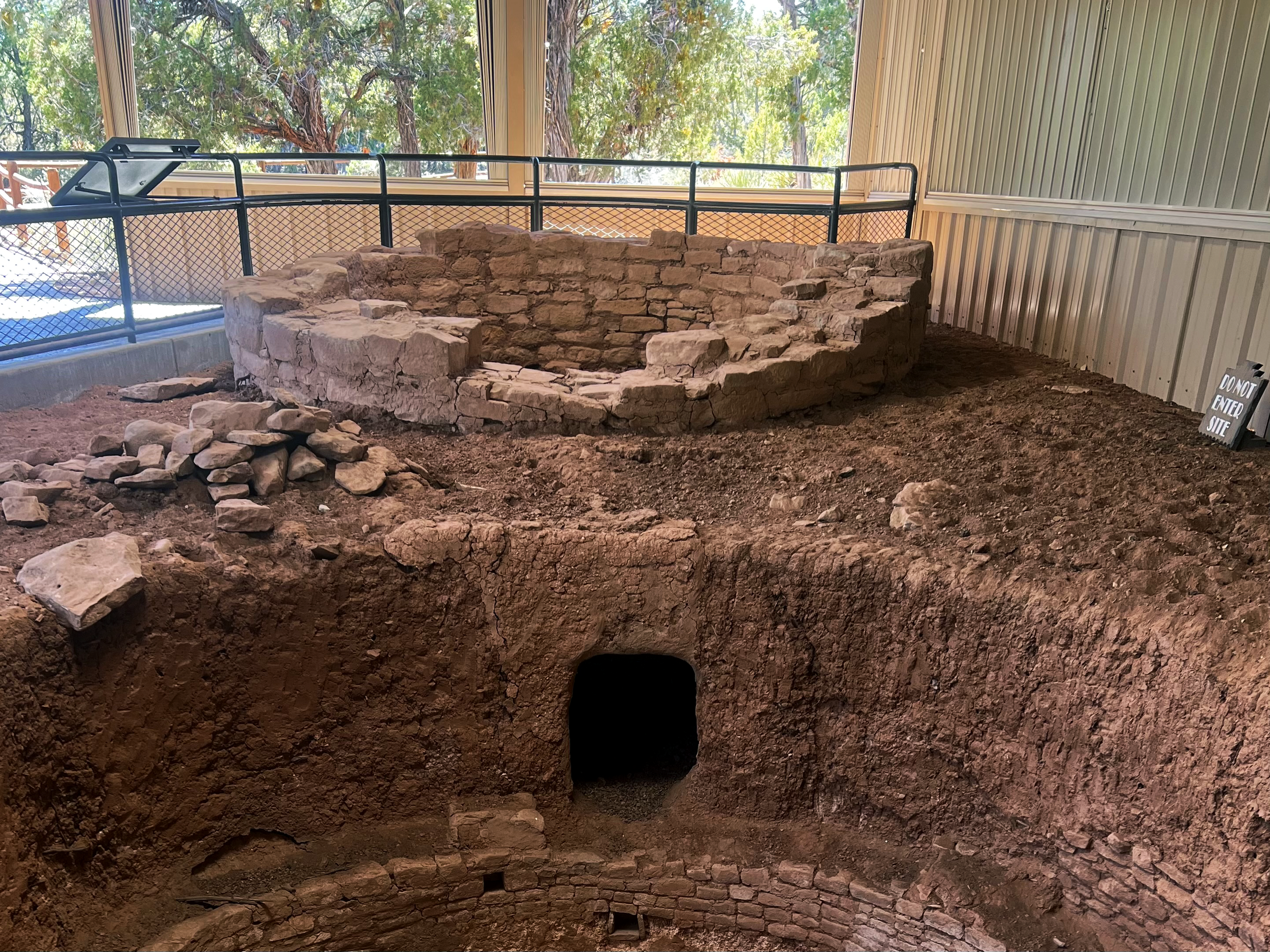
Excavated pithouse kiva at Mesa Verde National Park
An Uncertain Future
Shortly after America’s 250th birthday, Mesa Verde was referenced by Iranian-American architect Nader Tehrani in TIME Magazine:
UNESCO World Heritage Sites like Mesa Verde National Park in Colorado, Monticello in Virginia, the Guggenheim Museum in New York City, and the Statue of Liberty recognize the diverse histories of this region and embody the values of the people who lived on these lands for centuries, redefined liberty, and imagined its future. Our cherishing of these sites highlights the irony of the fact that the U.S. war on Iran, supported by our tax dollars, has damaged other world heritage sites—an offense unlikely to have clear legal accountability, due to this country's refusal to ratify the International Criminal Court's Rome Statute.⁵
Tehrani’s statement emphasizes a pressing ideology in America: who gets to decide what is valuable enough to preserve and protect?
In March 2025, Donald Trump issued Executive Order 14253, titled “Restoring Truth And Sanity To American History.” Section 4 requires that the Secretary of the Interior shall
Ensure that all public monuments, memorials, statues, markers, or similar properties within the Department of the Interior’s jurisdiction do not contain descriptions, depictions, or other content that inappropriately disparage Americans past or living (including persons living in colonial times), and instead focus on the greatness of the achievements and progress of the American people or, with respect to natural features, the beauty, abundance, and grandeur of the American landscape.⁶
With this order, Trump‘s scope creeps beyond the last 250 years of American history. To address his orders, the National Park Service put up QR codes asking for public feedback on NPS signage, placing the burden of censorship on the public.⁷ The role of surveillance has been crowdsourced to families, hoping to audit all of the national parks in one summer road trip. Meanwhile, accessibility upgrades in National Parks that would increase access for more Americans are severely lacking.
Signage at Mesa Verde National Park and Rocky Mountain National Park in Colorado were flagged for review under this executive order, presumably for mention of climate change.⁸ Despite this audit, climate change is undeniably threatening archaeological sites in Mesa Verde National Park. Archaeologists have posited that Ancestral Puebloans themselves may have left the area in the 13th Century due to extreme drought and violent warfare (potentially due to dwindling resources). Kate Siber, a freelance writer based in Durango, explains that “in Mesa Verde, the first national park established to protect archaeological resources, cliff disintegration, wildfire, loss of surface water and the proliferation of invasive species are the biggest climate-related threats to park resources.” ⁹
At Mesa Verde National Park, signs pepper the roadway to memorialize the sites of wildfires throughout the park’s history. Since its founding in 1906, Mesa Verde has lost half of its forest cover to wildfire. Fires exacerbate the already-arid landscape, and increase the risk of flash floods by depositing a hydrophobic layer over the soil, where water cannot seep in.⁹ Architectural sites within Mesa Verde National Park are particularly vulnerable to water damage, especially flooding events. Climate change also threatens the sandstone arch into which Spruce Tree House is tucked. Larger swings in temperature from summer to winter are accelerating the arch’s collapse by increasing the frequency of freeze-thaw cycles, creating large, unstable cracks in the rock.
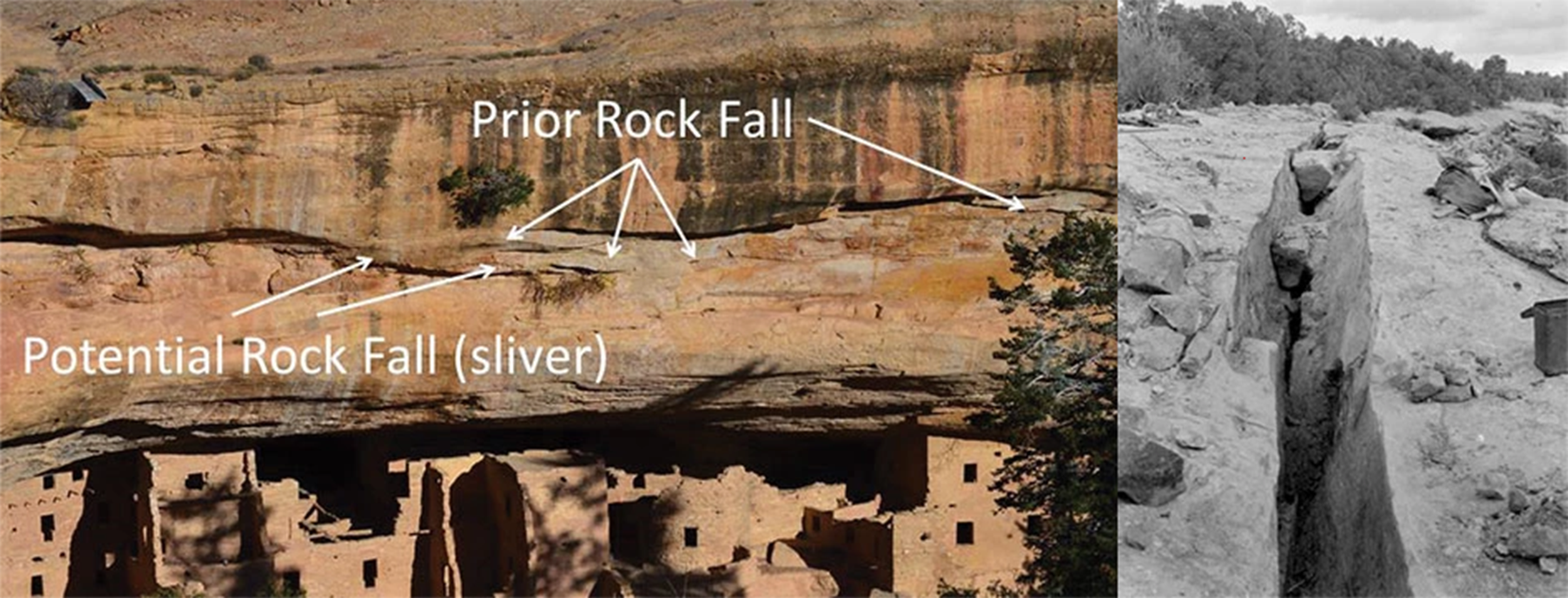
Rockfall and cracks in the sandstone above Spruce Tree House, copyright NPS
When I visited Mesa Verde, it was a sweltering 95 degrees in late June. Cars and dogs alike overheated and panted, door handles stung. My legs burned on the car seat after stepping out to an overlook for a few minutes. I felt the urge that humans weren’t meant to be here, and I could understand why they may have left magnificent homes in the face of climate threat.
In more recent history, the Trump administration reduced two other national monuments in southern Utah: Bears Ears and Grand Staircase-Escalante National Monuments. These sites have been reduced by a combined three million acres, a roughly 90% reduction of each National Monument. Both lands contain archaeologically significant Ancestral Pueblo cliff dwellings and petroglyphs, but state officials lobbied to make these lands available for private development due to the presence of coal and uranium deposits.¹⁰ Nearby, Canyonlands National Park bears permanent scars from uranium mining in the area decades prior; long, linear scratches visible from miles away.
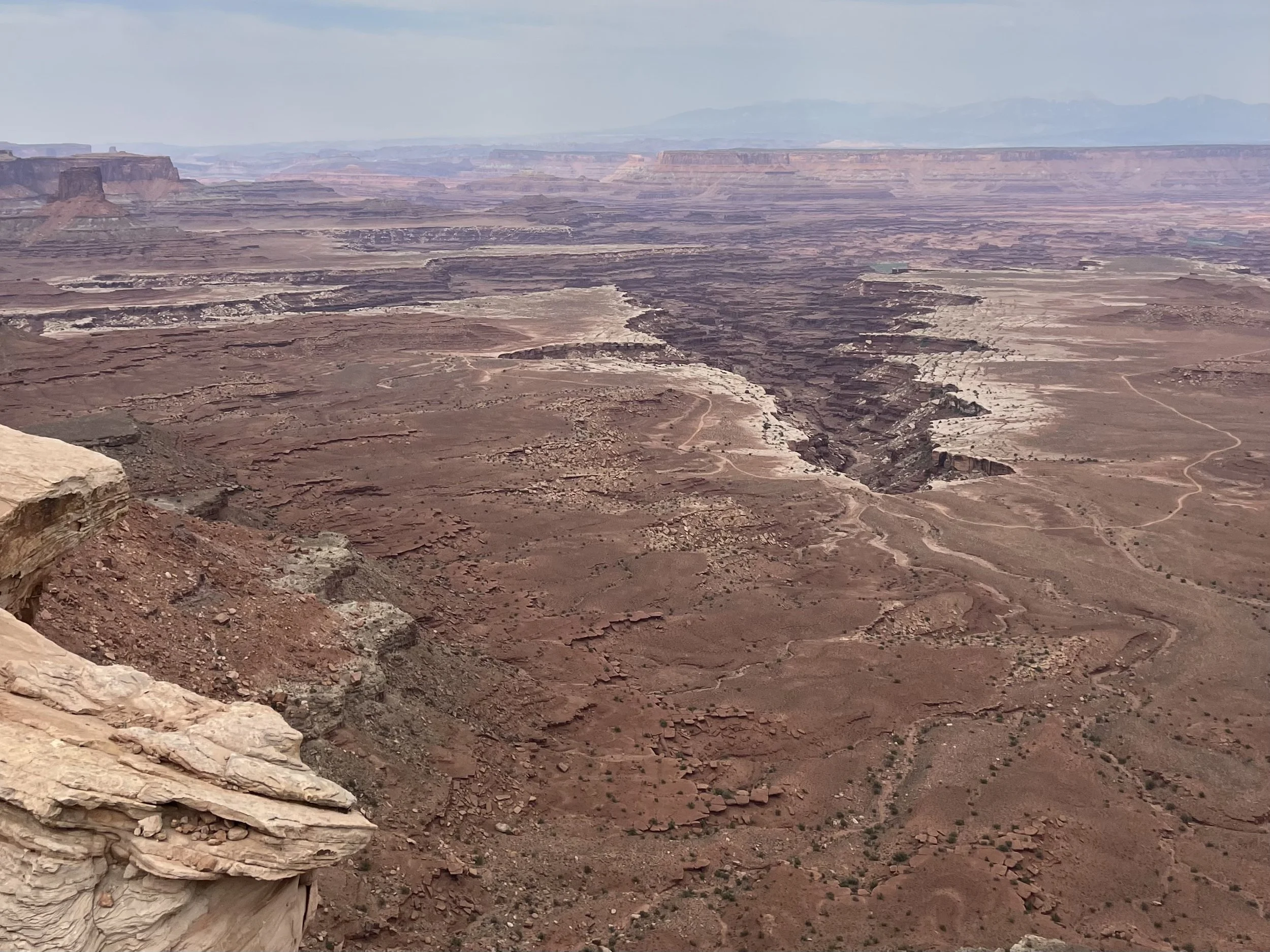
Canyonlands National Park in Utah
Trump’s proclamation also disbanded the Bears Ears Commission, a formal panel comprised of members of the Hopi Tribe, Navajo Nation, Ute Mountain Ute Tribe, Zuni Tribe, and the Ute Indian Tribe of the Uintah & Ouray Reservation. Tribal leaders were not advised or informed of this decision.¹¹
We may celebrate “America 250” in 2026, convince ourselves that this is where history began, but the land won’t acknowledge that.
Aryana Leland is a designer and writer based in Denver, Colorado. Originally from Southern California and born on the Fourth of July, she earned her Bachelor of Architecture with a Minor in Art History from Cal Poly Pomona.
All opinions are my own.
“Missing and Murdered Indigenous Women and Relatives.” National Indigenous Women’s Resource Center. https://www.niwrc.org/mmiwr-awareness
Asante-Muhammad, Dedrick, Esha Kamra, Connor Sanchez, Kathy Ramirez, and Rogelio Tec. “Racial Wealth Snapshot: Native Americans.” National Community Reinvestment Coalition (NCRC), February 14, 2022. https://ncrc.org/racial-wealth-snapshot-native-americans/
“Spruce Tree House Closure.” National Park Service, April 21, 2025. https://www.nps.gov/meve/planyourvisit/sth_closure.htm
“Museum Renovations.” National Park Service, December 31, 2025. https://www.nps.gov/meve/museum-renovations.htm
Tehrani , Nader. “A Portrait of America in 25 Buildings and Monuments.” TIME 208, no. 1/2, July 6, 2026. https://time.com/collection/our-america-250/2026/american-buildings-and-monuments/
“Restoring Truth and Sanity to American History.” Executive Order 14253. The White House, March 27, 2025. https://www.whitehouse.gov/presidential-actions/2025/03/restoring-truth-and-sanity-to-american-history/
Forrest, Brett. “‘Don’t Erase History’: FOIA Dump Reveals Backlash to National Park QR Code Campaign.” KOAA News5 Southern Colorado, June 7, 2026. https://www.koaa.com/advocates-of-accountability/dont-erase-history-foia-dump-reveals-backlash-to-national-park-qr-code-campaign
Spencer, Ryan. “At Colorado’s National Parks, Signs about Ute History, Pikas and Alpine Tundra Flagged for Potential Removal under Trump Orders.” Summit Daily, March 24, 2026. https://www.summitdaily.com/news/colorado-national-parks-ute-history-removed-trump-orders/
Siber, Kate. “An Uncertain Future.” National Parks 91, no. 4 (2017): 36–43. https://npshistory.com/npca/magazine/fall-2017.pdf
Brown, Matthew, and Savannah Peters. “Trump Reduces Size of 2 National Monuments in Utah as Republicans Reshape Land Management.” AP News, July 14, 2026. https://apnews.com/article/trump-bears-ears-grand-staircase-escalante-69f14749f13a7ac6fb6ee07ce4cd84bf
“Trump Shrinks Bears Ears and Grand Staircase-Escalante by 90 Percent.” Center for Western Priorities, July 14, 2026. https://westernpriorities.org/2026/07/trump-shrinks-bears-ears-and-grand-staircase-escalante-by-90-percent/