
In America, disability rights activists have fought long and hard for equal access to the built environment. For over a century, disabled individuals were excluded from public spaces, employment opportunities, and in extreme cases, sterilized and institutionalized. Both World Wars brought veterans home with disabilities, increasing the visibility of disabled individuals and a push for resources by the government in recognition for their service. Despite this reality, the civil rights of disabled individuals weren’t ensured by law in the United States until the Rehabilitation Act was signed in 1973.¹
In March 1990, a prominent protest brought activists face to face with Congress, known as the Capitol Crawl. Sixty disabled activists made their way up the steps of the U.S. Capitol, abandoning their mobility aids and wheelchairs at the base.

The Capitol Crawl protest, March 12, 1990. Photo: Jeff Markowitz/AP Photo
Alt Text: Disabled activists on the steps of the United States Capitol during a protest in 1990, with onlookers and the Capitol building in the background.
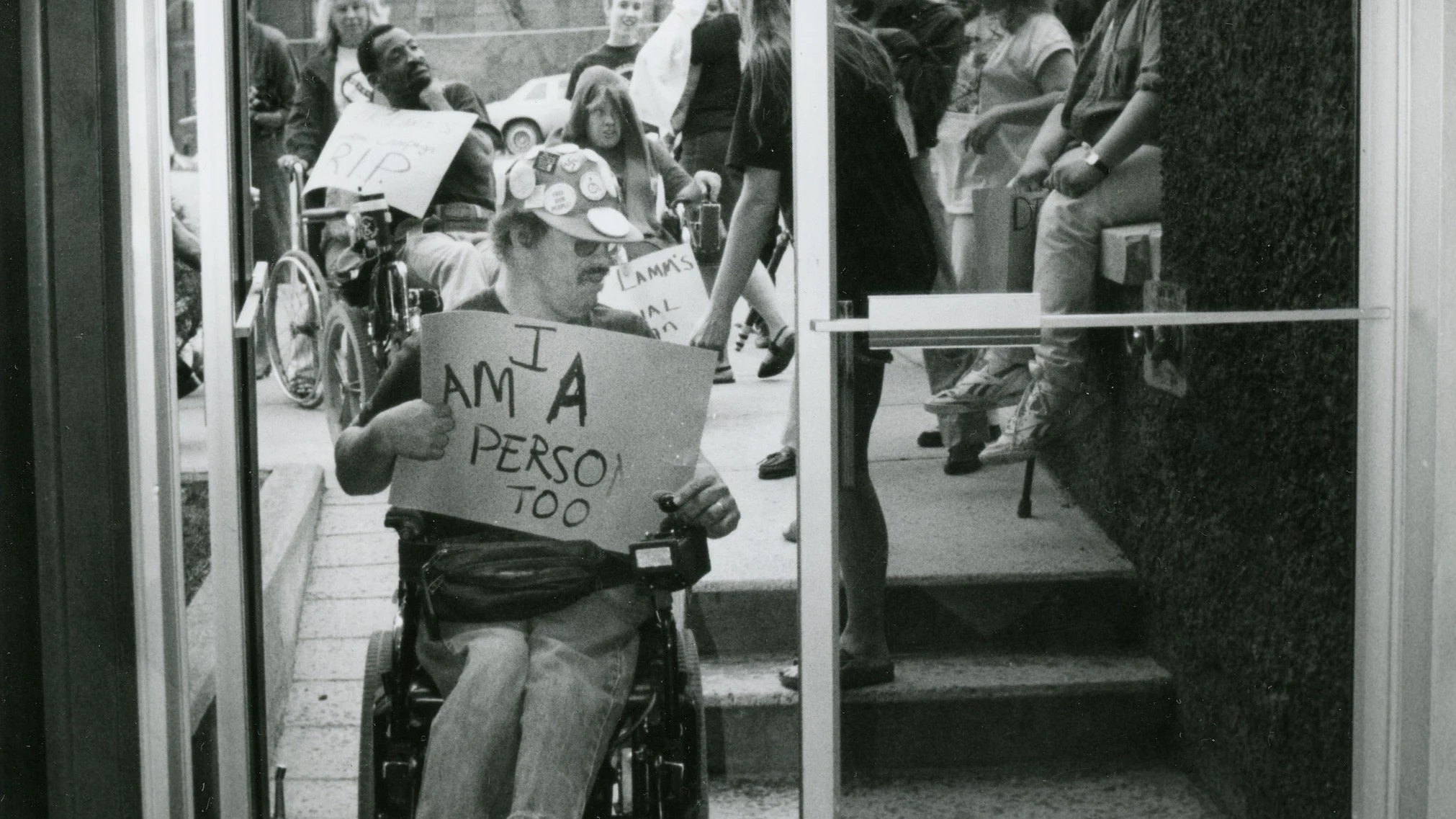
(Header Image: Member of Denver’s Gang of 19, from the documentary 30 Years Later: How the ADA enabled Denver’s Disability Community to ‘Boldly Go Where Everyone Else Has Gone Before.’
Alt Text: A black and white photo of a wheelchair user in a doorway holding a handmade sign that reads “I am a person too.”)
The Americans with Disabilities Act was introduced to the federal government in 1988 and was signed into law just two months after the Capitol Crawl protest.² ³ Disability activists had been fighting for better access in a system that had created, reinforced, and upheld discrimination for far too long. This iconic protest has continued to inspire - last year, Utah residents commemorated the event at the State Capitol in Salt Lake City.⁴

Influencer Briel Adams-Wheatley (IG: @no_limbs_) makes her way up the Utah Capitol steps. Photo: Bethany Baker/The Salt Lake Tribune
Alt Text: A woman with tetra amelia syndrome smiles as she makes her way up the steps of the Utah State Capitol Building.
The Americans with Disabilities Act greatly improved accessible design in the United States by requiring it by federal law, establishing the exclusion of disabled people as discrimination. In 2026, the ADA celebrated its 36 year anniversary. Unlike building codes, the ADA is not updated on a regular schedule, and has a limited scope that may not reflect present day conditions. The ADA has been updated once (2010) since it was signed into law.⁵
Accessibility standards greatly impact the built environment, and how architects design for disabled users. With this in mind, how can architects look beyond potentially outdated, minimum requirements to create more inclusive spaces for all people?
In 2025, the National Council of Architectural Registration Boards (NCARB) conducted a survey in partnership with the National Organization of Minority Architects (NOMA) to identify accessibility challenges that candidates face on their path to licensure.⁶ This grew from a joint action plan to address disparities on the path to licensure. Important data about licensure and accessibility were revealed by the survey, but the report was noticeably flawed. For example, participants who reported having a mental health disorder, a speech-related disability, or a learning disability were all lumped into a single category of “neurodivergent.” NCARB justified this by stating that it was to ensure a valid sample size and statistical significance, but may indicate a larger gap between data and understanding disability in the architectural profession.
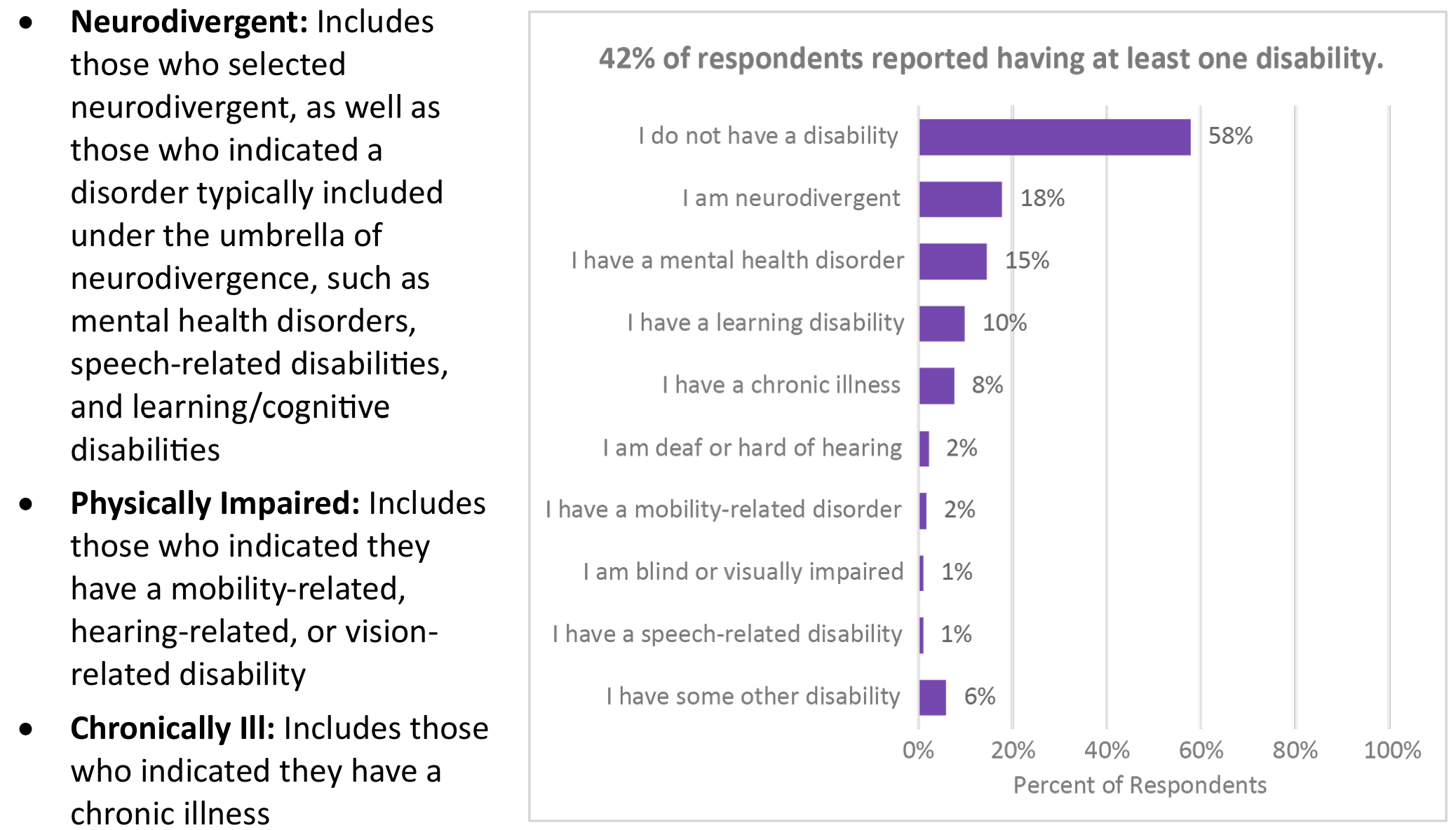
Graphic from NCARB’s “Accessibility and the Impact of Disabilities on Architectural Licensure” Survey, June 2025.
Alt Text: Bar chart demonstrating that 42% percent of respondents identified as having at least one disability. Top five responses from highest percentage to lowest: I do not have a disability (58%), I am neurodivergent (18%), I have a mental health disorder (15%), I have a learning disability (10%), and I have a chronic Illness (8%). Accompanying text for the bar chart indicates that the “I am neurodivergent” response includes any respondent who indicated mental health disorders, speech-related disabilities, and learning/cognitive disabilities.
Despite these concerns, there were a few key takeaways. First, candidates who have a disability experience significantly more barriers to licensure and in their architecture program than those who do not have a disability. This includes barriers to completing the Architectural Experience Program (AXP) and the Architect Registration Examinations (ARE).
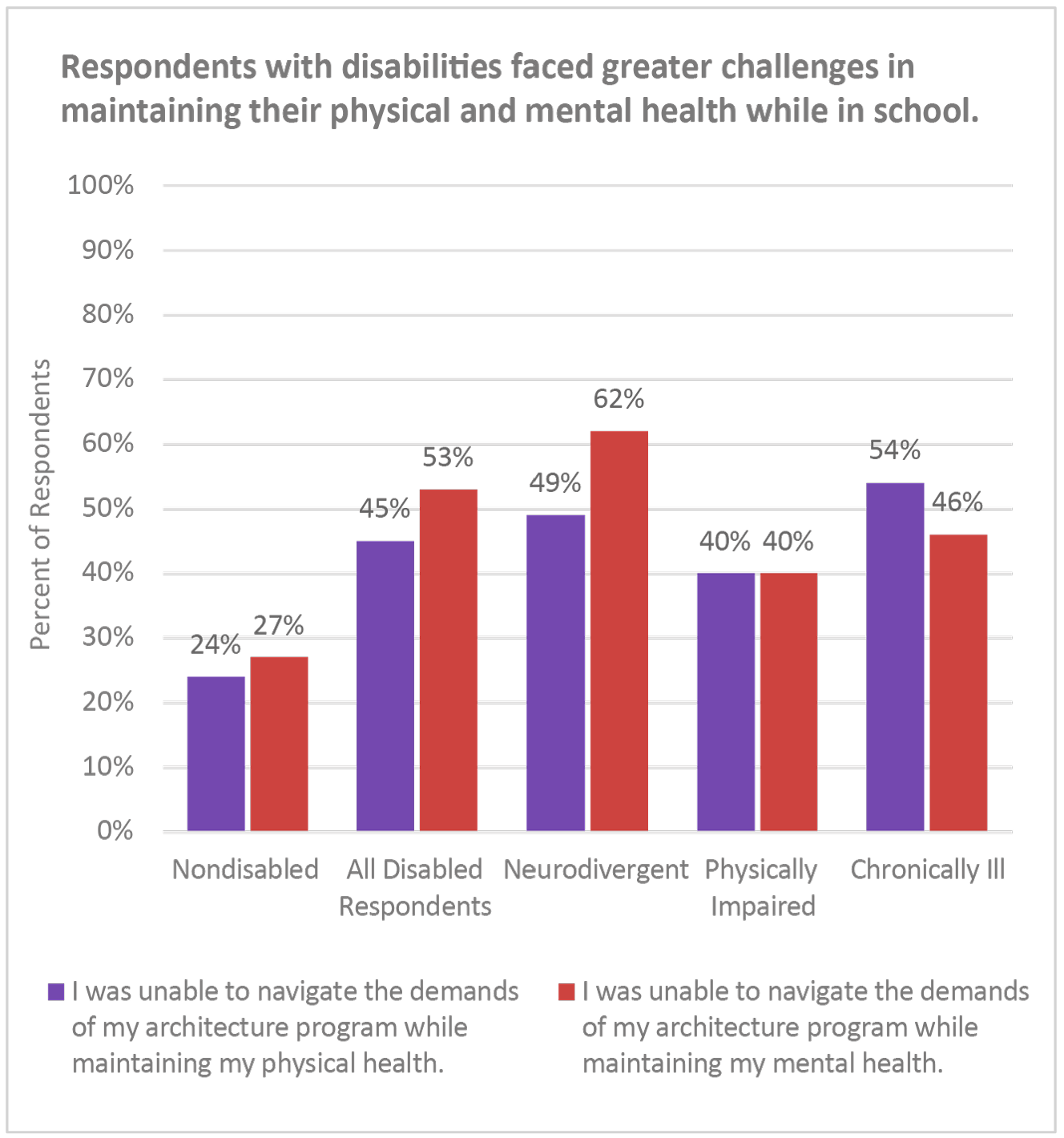
Graphic from NCARB’s “Accessibility and the Impact of Disabilities on Architectural Licensure” Survey, June 2025
Alt Text: Bar chart demonstrating that respondents with disabilities faced greater challenges in maintaining their physical and mental health while in school. For example, 45% of all disabled respondents were unable to navigate the demands of their architecture program while maintaining their physical health, where only 24% of nondisabled respondents agreed with the same statement.
One respondent with a learning disability, for example, reported difficulty with reading comprehension needed to succeed in school and on the ARE’s. Another respondent with physical impairments has faced difficulty with equal access to site visits, which are critical to earning both educational and professional experience.⁶
Currently, there is insufficient data in the United States to grasp how many licensed architects live with a disability. NCARB provides optional self-reporting for licensure candidates regarding disability status, but the number of candidates who have reported is well below the minimum sample size for NCARB reporting. Across the pond, however, the Royal Institute of British Architects reports that only 1% of licensed architects are disabled.⁷
These demographics may be understood through a different lens: those who design the built environment and public spaces most often do not have the lived experience to understand barriers for disabled users. Paired with the understanding that code-required accessibility measures may be outdated, or narrow in scope, some architects have begun to advocate for a broader perspective. Inclusive Design attempts to bridge this gap, bringing empathy, evidence-based design, and the lived experience of diverse users to the forefront.
INCLUSIVE DESIGN IN PRACTICE
I was introduced to the concept of Inclusive Design working at Gensler’s Denver office, where I’ve had the privilege of collaborating with incredibly knowledgeable, thoughtful project teams early in my tenure. Architects at Gensler have begun to research and implement Inclusive Design in their work. In workplace projects for example, office spaces need to accommodate a diverse range of users and their needs for an extended period of time each day, emphasizing the importance of Inclusive Design.
While researching Inclusive Design, I had the pleasure of chatting with Abigail Parr (she/her/hers), a Technical Director and Regional Inclusive Design Co-Leader with 18 years of experience at Gensler. In our Denver office and beyond, Parr has taken the reins to educate others on the principles and practice of inclusive design in our work. “I work with project teams to embed inclusive design principals into the design process not as a checklist, but as an integral part of good design,” she explains.
When introducing Inclusive Design to project teams or clients, Parr asks them to think of a time when they felt excluded. “We can all imagine how it might feel to be excluded from a public space or a social group. And if designers don't have the lived experience of disability itself, we can at least tap into our own empathy as it relates to exclusion.” She follows this by explaining that spaces, particularly public spaces, should be designed for the greatest number of people whenever possible.
She gives an example of destination dispatch elevators, which often rely on a touch screen at a kiosk in order to reduce waiting times for users. Destination dispatch is becoming increasingly desirable for clients, but Parr explains that these may not provide equal access for those with visual impairments.
Abigail and I chatted over coffee in a public plaza in Downtown Denver, where the importance of Inclusive Design revealed itself in real time. The plaza is separated from traffic by grand steps, with a narrow ramp sequestered off to the side of the plaza. On the sidewalk, a woman in a wheelchair waited in the sun while the bus slowly extended a ramp for her to board.
I asked Abigail to explain the difference between Inclusive Design and Universal Design, which are often conflated. She explains that “Universal Design takes a ‘one size fits all’ approach and is based on principles, and best practices. Inclusive Design takes a ‘one size fits one’ approach, aiming to accommodate the needs of individual users by engaging those users in a design process that is inclusive of them. Every project is unique because every group of end users is unique.”
In designing the Hensel Phelps Corporate Headquarters in Loveland, CO, Parr met with the project team at Gensler at each design phase - SD, DD, and CD - to review the design through the lens of Inclusive Design. The project was driven by a goal to create a best-in-class workplace for their employees and is targeting WELL Platinum Certification, which awards buildings that prioritizes the health and wellbeing of its users.⁸ “I call it meddling,” Abigail jokes, "I meddle in the projects around me, whether I'm a project team member or not, to influence the teams toward more inclusive design features.” As a Technical Director, Parr’s additional role as a QAQC reviewer also allows her to review projects carefully for accessibility and inclusivity concerns.

Interior Rendering of the Hensel Phelps Corporate Headquarters, architecture and interiors by Gensler Denver (all rights reserved).
Alt Text: Architectural rendering of an office interior. People are seen working in a sunny office with mass timber and glass design elements.
Parr finds herself needing to be a continuous advocate for Inclusive Design on project teams, but admits that client and budget constraints can be a limiting factor. “Asking a client to spend $15k on a gender-neutral restroom may not be reasonable if that is a large percentage of the overall project budget.” In the meantime, small changes can have a large impact. Parr makes a point to de-gender certain fixtures, such as providing waste disposal receptacles and diaper changing tables in both men's and women’s restrooms. She ensures that spaces like mother’s rooms and wellness rooms are integrated into a project from the beginning, with variety and flexibility in textures, colors, and lighting.
By the end of our discussion, Abigail reemphasized the need for Inclusive Design in architectural work. “The ADA is 36 years old. ICC A117.1 is updated every few years with minor changes, but does not address things like neurodiversity or gender identity, and has to be adopted by jurisdictions.”
Inclusive Design benefits more than those with visible disabilities by encouraging architects to design for the greatest number of people, and aims to actively engage with users beyond code-minimums. Firms like Gensler are taking steps to integrate these principles into their work and share their expertise through research.
LIVED EXPERIENCE
Current data shows that the majority of architects are not disabled themselves, but that those with a disability face major barriers to earning experience and their architecture license. While this is the case, becoming disabled is the only minority group that someone can join at any time, whether through illness, accident, or age. We all know or care about someone that may have a disability, whether seen or unseen, and will likely experience a disability ourselves at some point in our lives. With this in mind, architects need to accommodate this nearly universal experience and consult disabled users as experts of their own lived experience and the barriers they face in their built, and unbuilt, environment.
In the second part of this series, we’ll explore how Inclusive Design may be taken further by exploring peer-reviewed methods that bring those with communication differences, neurodiversity, or intellectual disabilities into the design process as active participants with expertise.
Aryana Leland is a designer and writer based in Denver, Colorado. She earned her Bachelor of Architecture with a Minor in Art History from Cal Poly Pomona.
All opinions are my own.
“A Brief History of the Disability Rights Movement.” Anti-Defamation League (ADL), November 22, 2024. https://www.adl.org/resources/backgrounder/brief-history-disability-rights-movement
Little, Becky. “When the ‘Capitol Crawl’ Dramatized the Need for Americans with Disabilities Act.” HISTORY, May 28, 2025. https://www.history.com/articles/americans-with-disabilities-act-1990-capitol-crawl
“THE WHEELS OF JUSTICE AND THE CAPITOL CRAWL.” Museum of Disability History. https://museumofdisabilityhistory.org/the-wheels-of-justice-and-the-capitol-crawl/
Jayswal, Palak. “Here’s Why 4 Utahns with Disabilities Chose to Crawl, Climb the Utah Capitol’s Marble Steps.” The Salt Lake Tribune, July 26, 2025. https://www.sltrib.com/news/2025/07/26/disabled-utahns-celebrate-35th/
“ADA Timeline.” ADA National Network | ADATA. https://adata.org/ada-anniversary-timeline/
“Accessibility and the Impact of Disabilities on Architectural Licensure.” National Council of Architectural Registration Boards, June 2025. https://www.ncarb.org/sites/default/files/BOB-accessibility-disability_report.pdf
“(En)Abling Architectural Research: Co‐Designing With People With Intellectual Disabilities.” Journal of Applied Research in Intellectual Disabilities. Jul2026, Vol. 39 Issue 4, p1-13. 13p. https://onlinelibrary.wiley.com/doi/10.1111/jar.70275
“WELL Certification.” International Well Building Institute. https://www.wellcertified.com/certification/v2/
“How the ADA Improved the Lives of Denver’s Disability Community.” City and County of Denver. https://www.denvergov.org/Community/Neighborhoods/Stories/Documentaries/Impact-of-ADA-30-Years-Later